Designing festival touchpoints
From discovery channels and decision-making sources to final purchase triggers and the ticket-buying journey, we highlight how UX (design) choices directly influence whether people commit to a festival.
Mar 10, 2026 – 7 min. read

Recommendations for organizers
Iteratively optimize the festival website
The festival website is the top decision source and purchase channel. Keep the festival website MUFA (mobile-first, up-to-date, fast, and accessible). Needs to provide clear ticketing details, line-up information, FAQs, transparent pricing, and multiple payment options, since AI tools also rely on this content for accuracy. Integrate user behavior analytics tools to help you understand how users interact with your website and/or conduct UX interviews with users. Reach out to experts like Amplify for “Journey Health Assessments” (UX audits).
Simplify purchase flows and provide payment plans
Offer clear layouts, multiple payment options, and avoid hidden fees to improve fairness and ease. Consider providing payment plans to boost fairness and trust. People also favor receiving some sort of loyalty discount or perk.
Optimize channels by audience age
Social media is top for discovery. Use TikTok/Instagram for under-25s, Instagram/Facebook for 26+, and newsletters for older audiences.
Drive purchase urgency
The lineup announcement, across all ages, often gives people that last nudge they need to grab their tickets.
Tailor campaigns/communication by segment
Emphasize FOMO messaging for those 25 and under, and early bird/limited-time pricing for 26+ groups (although early bird pricing can be used as a baseline incentive across all groups).
Strengthen peer and social channels
Build referral/“share with friends” programs since friends remain an important decision influence, especially for younger audiences. Maintain a strong social presence and consider partnering with artists to share announcements, but don’t rely solely on them.
Enhance UX year-round
Designing and assessing festival touchpoints and UX should happen continuously throughout the year.
Discovery & decision sources
Discovery of festivals remains dominated by digital channels, with festival-run social media pages leading across all age groups (71% under 25, 65% 26–40, 53% 41+); posts tend to reinforce trust and provide timely updates. Word-of-mouth also remains a universal driver, with more than half of all festival-goers citing friends and family recommendations as influential.
Younger audiences place greater importance on artist and band accounts. Traditional advertising methods like posters and flyers also remain relevant; in contrast, influencers have relatively little impact, influencing only 8% of those under 25 and a mere 2% of those over 41. Newsletters, meanwhile, are more commonly used by older audiences.
Once interest is sparked, the decision-making phase shifts to trust-based channels. The official festival website stands as the top source used for information (57% under 25, 62% ages 26–40, 64% ages 41+). About half of each age group tended to visit festival websites two to three times before purchasing, indicating they want reassurance before committing.
Festival social media pages and friends/acquaintances continue to be consistent sources as well. Artist and band posts play a secondary role, with 14–16% engagement across all groups, while ticket platform usage for event information (e.g. Ticketmaster), remains low at just 9–10% across all age groups.
The final push to purchase
The point where intent transforms into purchase is driven by a mix of shared and age-specific triggers. Across all age groups (n=2928), the most decisive moment is the line-up announcement, motivating nearly half of each age group (46% under 25, 49% ages 26–40, 50% 41+). Having friends interested in the event is the next most powerful driver, particularly among younger demographics (46% of those under 25 and 45% of those aged 26 to 40), underscoring the inherently social nature of festivals.
Fear of missing out (FOMO) is a distinctly youthful trigger, with 26% of under-25 respondents admitting it pushes them to buy. Early bird/limited-time discounts resonate a bit more with 26+ attendees, with nearly one in four citing them as a decision factor. Payment plans resonate most with the 26–40 group (14%), providing financial flexibility at what is often a busy life stage balancing expenses.
Other tactics, such as email reminders and price increase alerts, show minimal impact across all age groups, suggesting that organizers should refocus investment toward more impactful drivers: strong line-up communications, peer-driven campaigns, targeted marketing aligned with audience motivations, and payment flexibility.
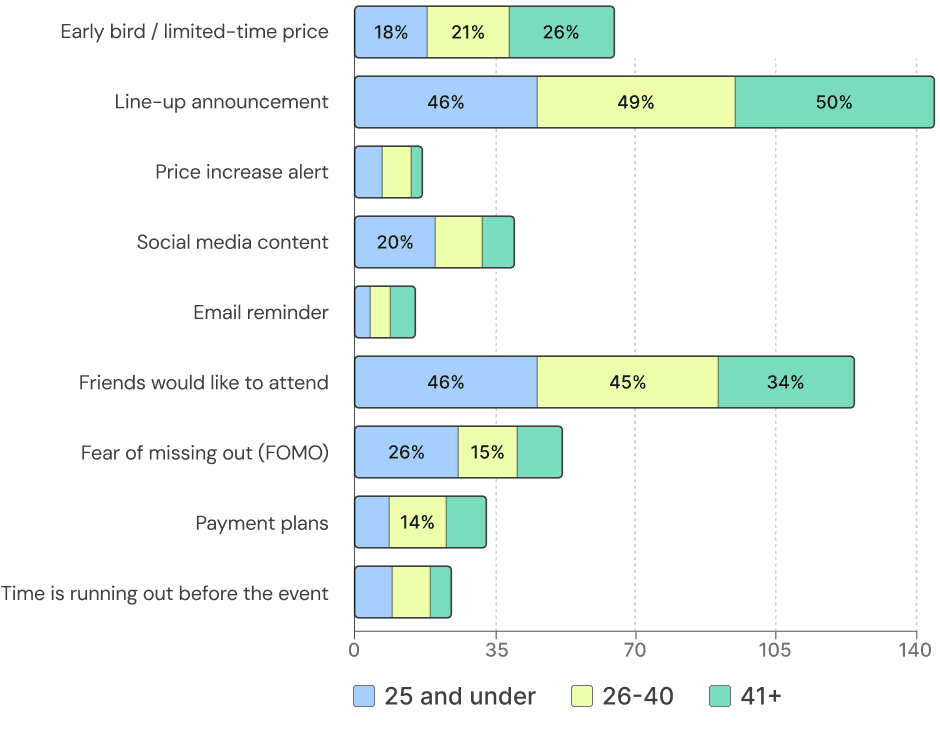
Motivators behind the final push to purchase a festival ticket
Stacked percentage by age group
Frustrations in the ticket buying experience
The majority of respondents view ticket-buying as a straightforward process, yet subtle differences emerge between age groups. The 26–40 age group reports the smoothest ticket-buying experience, with more than half (52%) rating it as “very easy.” In comparison, only 36% of users aged 25 and under and 47% of those 41 and older said the same, highlighting generational differences in digital habits and expectations. Also, interestingly, the 25 and under group has the highest proportion of neutral responses (21%).
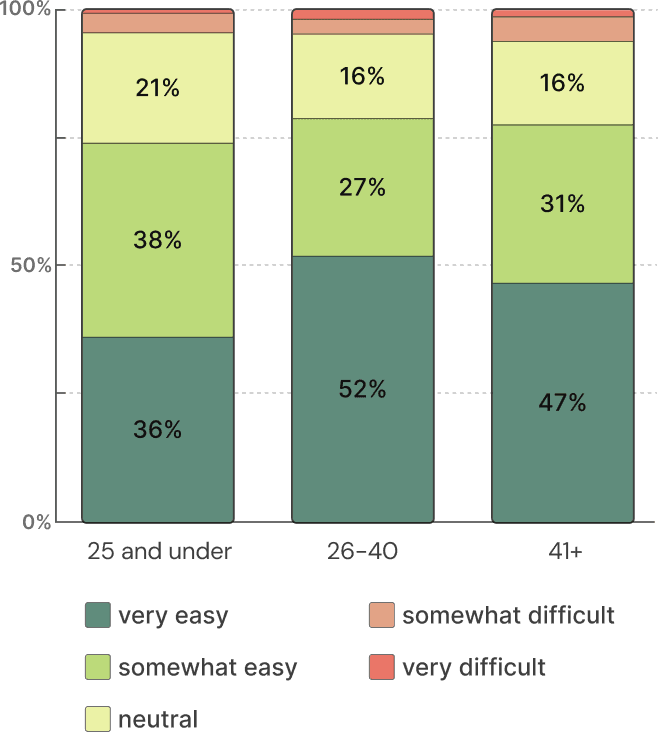
Festival ticket purchase difficulty
Stacked percentage by age group
Despite generally high satisfaction, specific frustrations persist (n=121). Website and app performance (slow loading, crashes) and responsiveness are the most commonly reported challenges. 46% of under-25 and 41% of older attendees experience these problems, compared to 28% of the mid-age group. Younger fans also struggle more with finding tickets and key information, pointing to opportunities for clearer navigation and design.
Older audiences are most vocal about tickets selling out too quickly (47% of 41+ report this as a frustration), revealing concerns about fairness in allocation. Payment difficulties and confusing steps to purchase increase with age. While less frequent, account creation/login problems and underwhelming customer support remain notable issues affecting up to 20% of older respondents.
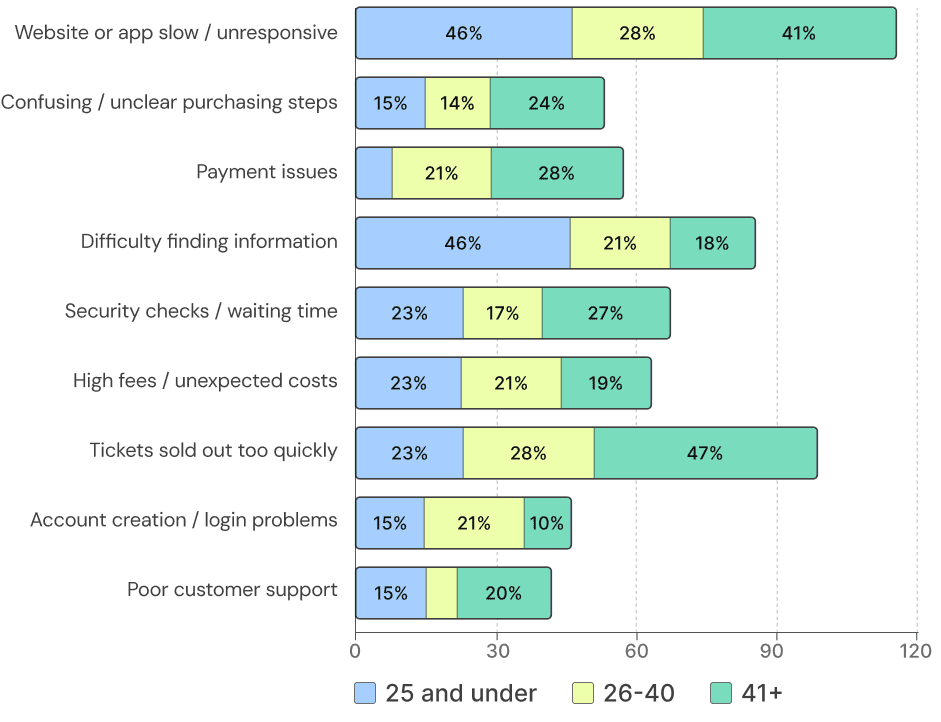
Challenges in the ticket-buying process
Stacked percentage by age group
Open-ended feedback included frustrations like discovering mandatory (camping) fees and add-ons later in the process. By contrast, organizers offering transparent, bundled pricing (e.g. ticket + camping) and payment plans are praised. Comments also highlight inflated on-site food and drink prices as an additional stress point, raising affordability concerns.