Safety, sustainability and inclusion
Think about the last festival you went to. Did you find yourself looking for clear signs to point you in the direction of your camping zone? Did you notice cups piling up on the floor as the day went on? Perhaps the facilities felt easy to access, or perhaps you struggled to get where you needed to go.
Mar 13, 2026 – 9 min. read
Today’s festival-goers expect more than just music and fun — events are also about safety, sustainability, and inclusion. They’re about creating a space where everyone feels welcome, cared for, and part of the experience.
Recommendations for organizers
Enhance safety and wayfinding
Have clearer signage and information, more visible security/staff, and better crowd control.
Encourage visible and easy to adopt sustainability efforts
Expand recycling and waste sorting, offer compostable/reusable cups and plates, and have more eco-friendly food and drink options. Incentivizing public transport and carpooling particularly appeals to under-25s. It’s also important to effectively communicate about sustainability initiatives.
Create both physically and digitally accessible experiences
Have accessible facilities for people with disabilities, expand quiet/relaxation spaces, and have diverse artist lineups. Also important to improve disability information and general accessibility on websites.
Build festival websites with flexible financial options in mind
Since 84% of respondents purchase tickets directly through the official site, optimizing the usability of this channel is essential. Introduce and communicate installment plans early on in the ticket buying journey and provide multiple payment options (e.g. Apple Pay, PayPal, Klarna, etc.) to broaden accessibility.
Safety
When we asked festival-goers (n=352) what they would like to see improve from a safety point of view, across all age groups, there’s demand for:
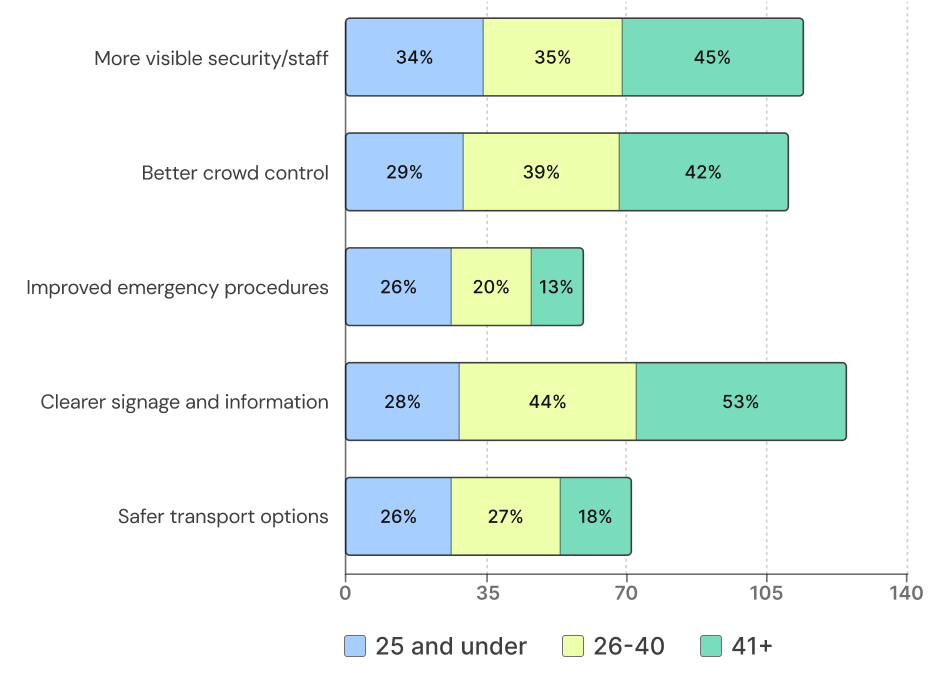
Safety improvements
Stacked percentage by age group
For 26-40 year olds, for example, they’d like there to be clearer signage (44%), better crowd control (39%), and visible security/staff (35%).
Some recommendations include using large, consistent signage to guide attendees to stages, exits, amenities, and emergency services. Good signage reduces confusion so people can focus on the event itself. These physical signs can also be supplemented with festival app maps to enhance navigation. Staff should be clearly identifiable by wearing designated safety vests or uniforms that distinguish them from attendees, helping to prevent impersonation. Additionally, staff should be trained equally in customer service and safety protocols to maintain an approachable yet authoritative presence throughout the festival.
Building a sustainable festival future
Building a sustainable festival future requires aligning green initiatives with the expectations and behaviors of diverse attendee groups. Among those surveyed (n=349), there’s a consistent demand across all ages for:
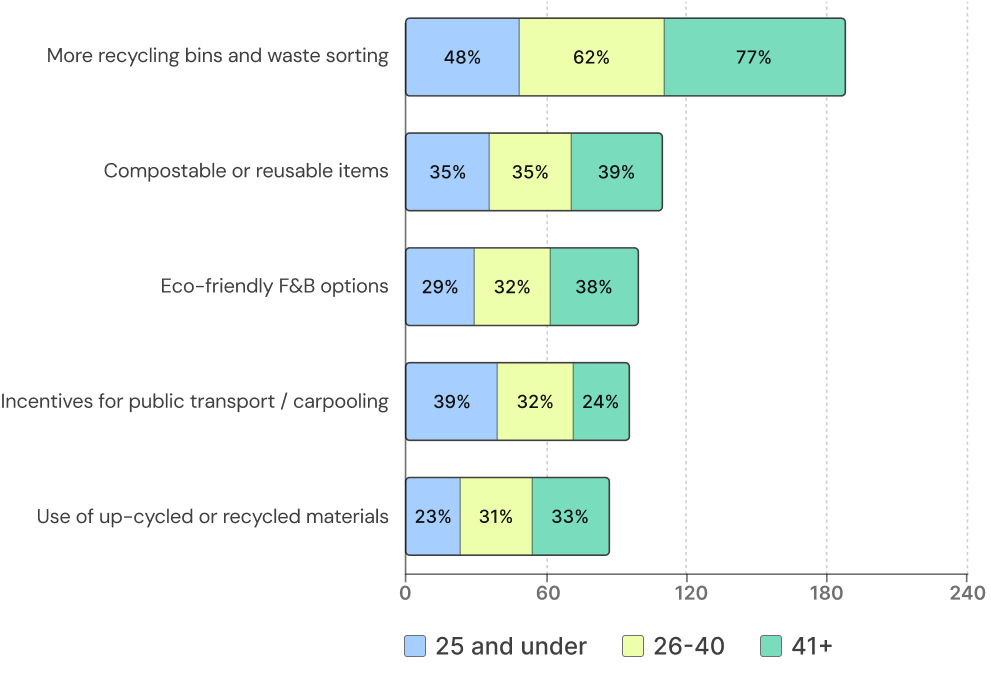
Sustainability improvements
Stacked percentage by age group
Attendees seek eco-friendly initiatives that are both visible and easy to adopt. 41+ festival-goers strongly called for more recycling and waste sorting (77%) compared to 48% of under-25s. For under-25s, the sustainability journey begins before the festival gate; 39% highlighted the importance of incentives for public transport or carpooling.
On top of this, effective audience communication is crucial for sustainability initiatives. Adoption depends not only on infrastructure but also on whether attendees understand the behaviors expected, perceive value in them, and feel motivated to act.
Emphasizing the importance of these initiatives — and integrating gamified elements where suitable — has the potential to boost engagement and foster a collective commitment to eco-friendly practices.
Accessibility and inclusion
In the context of a music festival, inclusion and accessibility guide the planning and design of an event to ensure everyone can participate fully and comfortably:
Designing and organizing the festival so physical spaces, materials, and digital tools/services are usable by people with a wide range of abilities. This could include websites and features like wheelchair access and accommodations for sensory needs so all attendees can navigate and enjoy the event.
This is a broader concept than accessibility — it’s about how we can create an environment where diverse groups feel welcomed, respected, and valued. It focuses on understanding and enabling people of all backgrounds and abilities. This could include curating diverse programming, using inclusive marketing, and actively learning from their lived experiences to continuously improve future events.
Festivals that prioritize accessibility create inclusive environments where people with disabilities can enjoy the experience. Beyond needing to comply with accessibility regulations, investing in (both physical and digital) accessibility delivers clear benefits. These include attracting larger, more diverse audiences, boosting ticket sales, and fostering loyalty among attendees.
Based on feedback from respondents (n=323), inclusion remains central to shaping satisfaction. Key needs across all ages include:
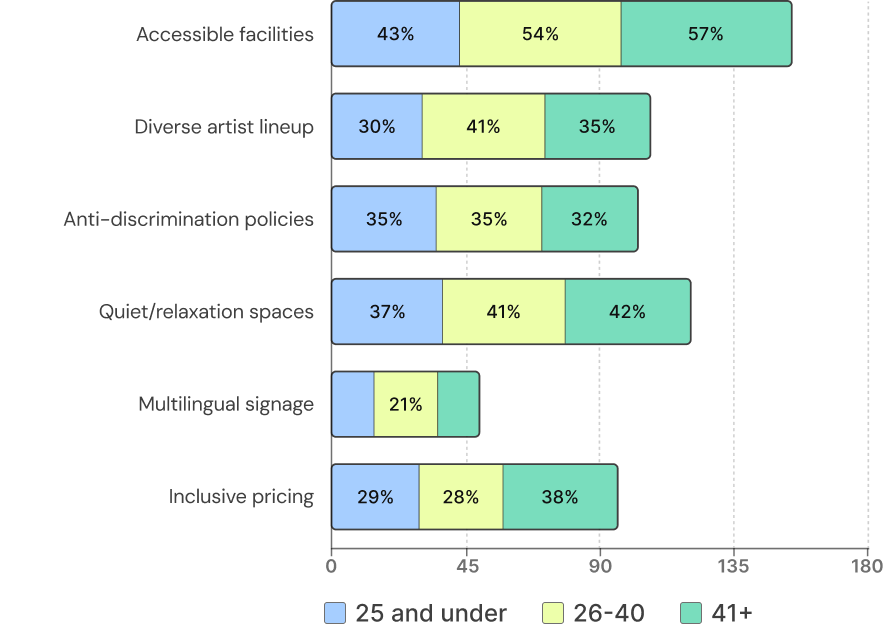
Accessibility improvements
Stacked percentage by age group
The 41+ age group again lead on accessibility concerns, with strong demand for accessible facilities (57%), relaxation spaces (42%), and inclusive pricing (38%).
The majority of attendees purchase directly through the official website (77% under 25, 82% aged 26–40, 88% aged 41+). When accessibility information is hidden or unclear — and the site itself is not accessible — it directly impacts potential buyers.
“Make the disability tickets clear on the website so we are not buying a full adult ticket and child till after the fact then having to bring id when it should already be in ticket.”
31–35 year old
“It’s important that the festival is appropriate for and makes special accommodations for people with special needs.”
Over 46
“More information on disability accessibility for tickets please.”
Over 46
“Sometimes securing disability access tickets can be difficult due to lack of communication I.e.. the promoters not responding to emails.”
Over 46
For many festivalgoers, clear accessibility info isn’t a detail — it’s what makes them feel included and confident when buying tickets. Consider involving experts in accessible design to evaluate current strategies and highlight areas needing enhancement.